


Discover complete Vastu rules for mandir placement in home setups. From northeast direction guidelines to bedroom, kitchen, and living room temple placement tips, this guide covers everything
If there is one thing that every Indian home, whether it is a 1BHK flat or a big independent bungalow, has always made space for, it is the mandir. Because no matter how busy the morning gets, the first thing most of us do after waking up is go to the pooja ghar, light a diya, fold our hands before Bhagwaan Ji, and ask for a good day. That moment of standing before the mandir in the morning is something that no app, no productivity hack, and no wellness routine has ever been able to replace in an Indian home.
But here is something many people either do not know or do not pay enough attention to, and that is the placement of the home mandir matters as much as the mandir itself. Vastu Shastra has very clear rules about where the mandir should be, which direction the idols should face, at what height the whole setup should sit, and which rooms are suitable and which are not. Getting these things right from the beginning, especially when setting up a new home is what keeps the energy of the pooja ghar clean, positive, and undisturbed.
So in this blog, we are going to walk you through every rule of mandir placement as per Vastu room by room, direction by direction, and material by material. Let us get started!
The Mandir Is No Longer an Afterthought in Home Design
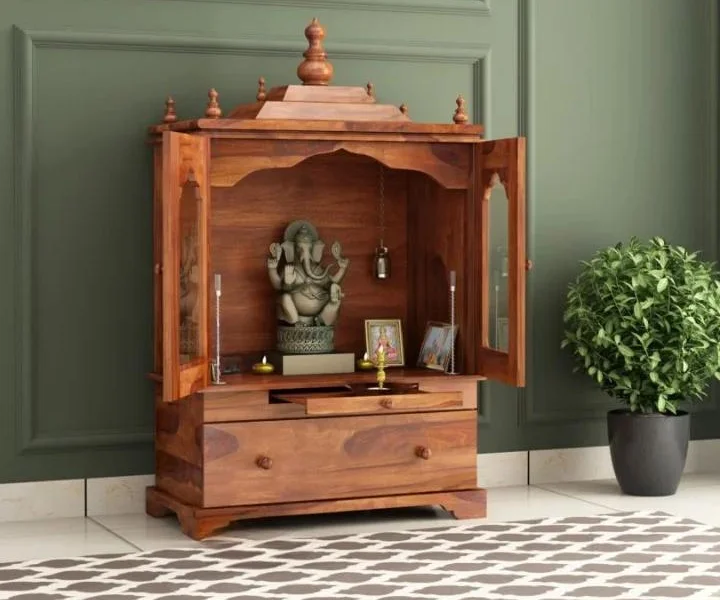
There was a time when the mandir in an Indian home was placed wherever there was a convenient little corner available, be it behind the door, on top of the fridge, in the spare bedroom that nobody used. But that approach has been changing a lot, and quite fast:
- Homeowners today are treating mandir placement in home as one of the most intentional decisions of the entire home setup. Not just for spiritual reasons, but because a well-placed, well-designed mandir adds real calm and rooted beauty to the home. Google searches for “mandir placement as per Vastu” have been growing every year, especially as more urban families move into new apartments and want to get things right from day one.
- The shift in thinking is very clear. Earlier, the mandir went wherever there was space. Today, temple placement as per Vastu, design quality, the right material, the right height, and the right direction, all of it is non-negotiable. People want the pooja ghar to feel like it belongs in the home, not like it was fitted in wherever it could go.
- And this matters practically – because placement, direction, height, material, and idol arrangement all carry both spiritual and visual weight. Getting any one of them wrong disturbs the whole sanctity of the space. So let us sort it all out.
The One Direction Rule That Overrides Everything Else
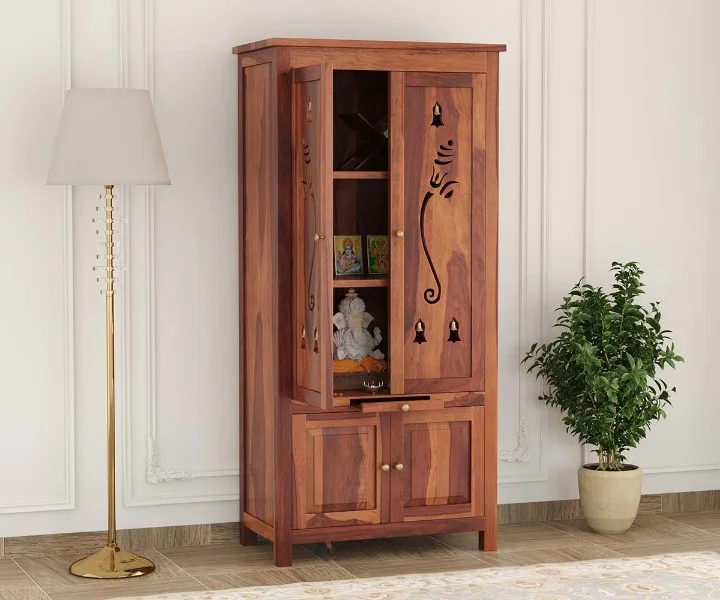
Out of everything in Vastu Shastra, the direction rule for mandir placement as per Vastu is the one with the most agreement across every school of interpretation. No debate, no regional variation, as everyone says the same thing:
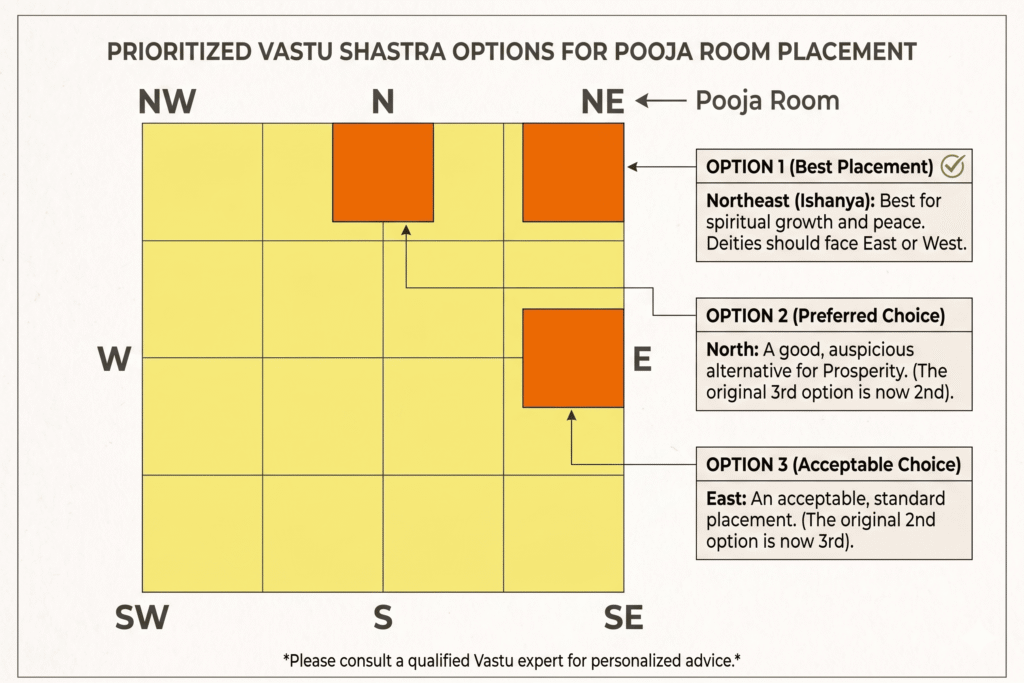
- The northeast corner, i.e. Ishan Kona is the best and most prescribed direction for mandir placement in home. This corner is the intersection of the north axis (associated with Kuber, the deity of prosperity) and the east axis (the direction of sunrise and new energy). Together, they make the northeast corner the most energetically active and spiritually charged zone of any structure.
- If northeast is not available, east is the next best option. When praying from the east side, the worshipper faces west, drawing energy from the rising sun. A very good secondary option when the northeast is blocked by layout constraints in mandir placement as per Vastu.
- South and southwest carry a clear prohibition. Associated with Yama and heavy, downward-pulling energy and no amount of layout pressure or space convenience makes south or southwest acceptable for temple placement as per Vastu. This is the one rule with absolutely no workaround.
Direction-by-Direction Vastu Verdict:
| Direction | Vastu Verdict | Reason |
| Northeast | Best | Ishan Kona: where north meets east, prosperity meets new energy, and both come together for the best mandir placement as per Vastu |
| East | Good | Sunrise direction: promotes clarity and positive energy for daily worship |
| North | Acceptable | Direction of Kuber: good for prosperity-linked prayers and daily pooja |
| West | Neutral | Not preferred but workable when no better option exists for mandir placement in home |
| South | Avoid | Associated with Yama: negative energy accumulates here and disturbs the sanctity of worship |
| Southwest | Strictly Avoid | Heaviest tamasic corner: completely unsuitable for any kind of temple placement as per Vastu |
Idol Facing Rule: The should always face east or west. The worshipper should face east or west while praying and never south. This applies regardless of which room the mandir sits in.
Room-Wise Mandir Placement in Home
The ideal situation is a dedicated pooja room. But in most Indian apartments today, especially 1 and 2 BHKs in metro cities, the mandir shares space with the living room, bedroom, or kitchen. Vastu has specific guidance for each of these situations, and the rules do not disappear just because the space is shared.
The universal principle across all rooms for mandir placement in home: the northeast corner of whichever room is selected, minimum 1.5 to 2 feet above floor level, and never placed directly on the ground.
Living Room
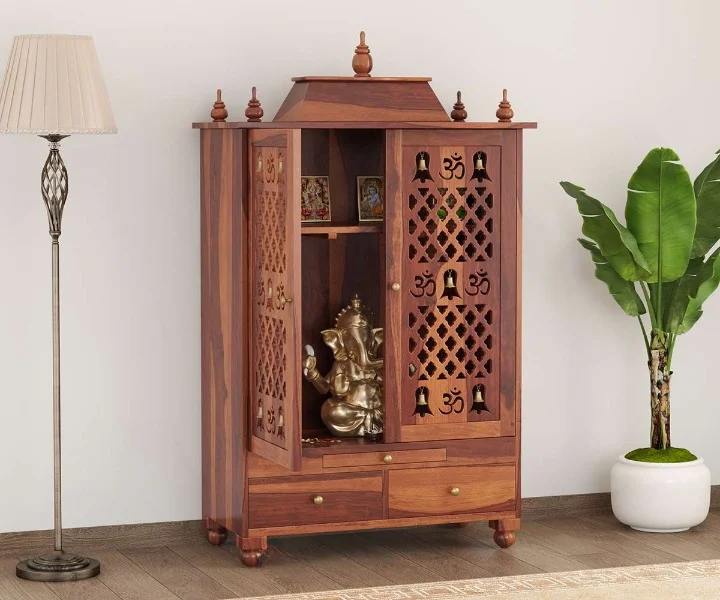
- The living room is the most Vastu-compatible space for a mandir after a dedicated pooja room. The northeast corner of a living room naturally gets good morning light and stays clear and positive. Temple placement as per Vastu in the living room northeast corner is always a well-supported decision for any Indian home.
- Keep the mandir at eye level or slightly above – between 2.5 and 4 feet from the floor. The idols of Bhagwaan Ji should not be looked down upon during daily activity or sitting conversations.
- Never place the mandir directly opposite the main entrance. Every time the main door swings open, it disturbs the sanctity of the space in front of it.
Bedroom
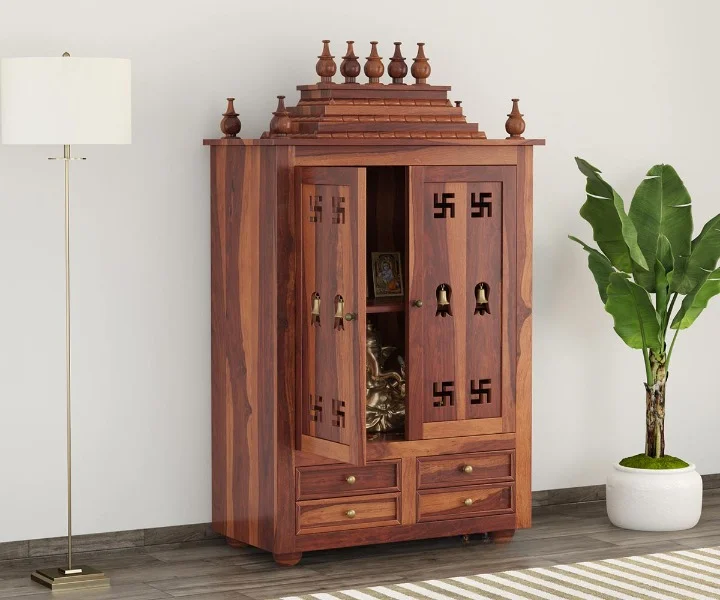
- Vastu strictly advises against a mandir in the bedroom. The bedroom carries the energy of rest and personal activity, i.e. a rajasic and tamasic mix that directly conflicts with the sattvic, pure energy that a mandir and Bhagwaan Ji deserve. This is the simplest way to understand why temple placement as per Vastu keeps the pooja ghar out of the bedroom wherever possible.
- If the bedroom is the only option available, then go northeast corner only, make sure the idols are covered with a small cloth curtain after evening prayers, and never position the mandir facing or adjacent to the bed directly. The bed should never share a wall with the mandir on the other side and the same rule applies to the toilet wall on any side of the mandir placement in home.
Kitchen
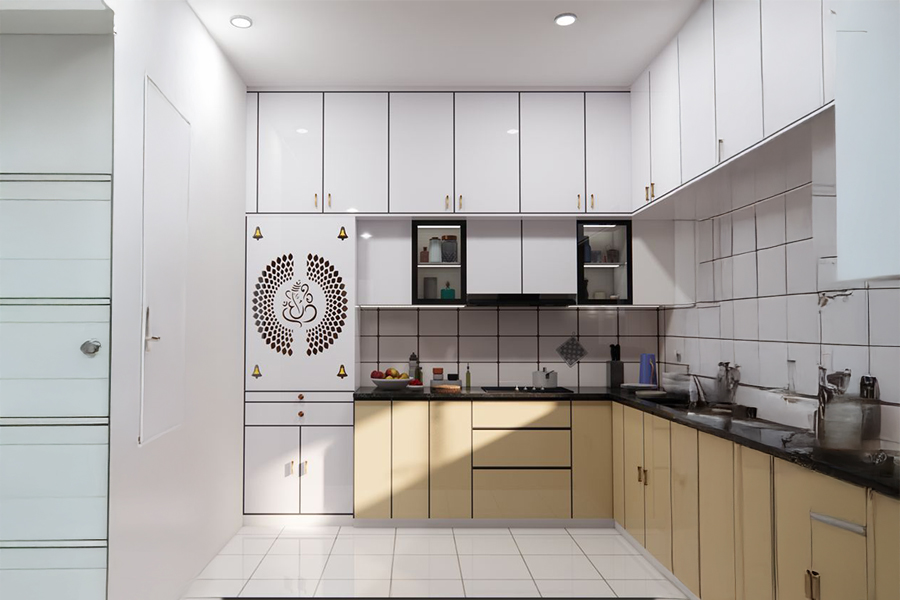
- Mandir placement in home in the kitchen is acceptable in Vastu only in the northeast corner – not near the stove, not above the sink, and not facing the cooking area. Temple placement as per Vastu in the kitchen keeps the fire zone (southeast) and the divine zone (northeast) at opposite ends of the room as they must not overlap.
- A small wall-mounted mandir unit with clear spatial separation from the cooking platform is the most practical solution for kitchen-based mandir placement as per Vastu. This keeps the sanctity intact without smoke, steam, and cooking smells from the stove reaching the pooja ghar directly.
- The entire room should sit in the northeast zone of the home’s floor plan – this is where temple placement as per Vastu begins for dedicated pooja rooms, not where it ends.
- The door of the pooja room should open towards the north or east so that when you walk in, you are naturally facing east, which is the direction of sunrise, clarity, and Bhagwaan Ji’s preferred facing direction.
- A threshold or doorsill is a Vastu requirement for a dedicated pooja room. It creates a clear physical and energetic boundary between the sacred space and the everyday space outside it. In South Indian homes especially, this doorsill is considered non-negotiable and is often made of brass or carved wood.
Temple Placement as Per Vastu: Idol-Specific Direction Rules
Not all deities follow the same directional rules, and Vastu prescribes specific positions for each form of the divine. This is the most detailed part of temple placement as per Vastu, and it applies inside the mandir unit regardless of which room or corner it sits in:
- Ganesha Ji – East-facing idol, placed near the entrance of the mandir or in the northeast corner. Ganesha Ji should be the first deity the worshipper sees when approaching the pooja ghar.
- Maa Lakshmi – North or northeast position, idol facing east. Never placed directly beside Ganesha at the same height, as there should always be a slight variation in positioning.
- Shiva Lingam – Placed in the north zone of the mandir, facing north. Should not be placed directly opposite a Krishna or Vishnu idol.
- Durga Ji or Maa Kali – South-facing idol with the worshipper facing north. This is the only major exception to the avoid-south rule in temple placement as per Vastu as the deity’s energy faces south to absorb and neutralise the heavy energy of that direction.
- Vishnu Ji, Krishna Ji, Ram Ji – East or northeast position, idol facing west so the worshipper faces east while praying – the ideal position for mandir placement as per Vastu for these deities.
The Vastu Checklist: Do’s and Don’ts for Mandir Placement
So before you finalise anything about mandir placement in home, here is a clear checklist that covers what to do and what to completely avoid:
Do these –
- Place the mandir at chest to eye level – between 2.5 and 4 feet from the floor. Bhagwaan Ji should never be below the eye line of the worshipper.
- Use marble, teak, sheesham, or stone for the mandir unit as these are the materials that retain positive energy and age beautifully over years.
- Ensure a natural light source from the east where possible. Where that is not possible, warm LED lighting inside or around the mandir is the minimum for any mandir placement as per Vastu.
- Maintain an odd number of idols – 1, 3, or 5. Even numbers are inauspicious in Vastu. Many Indian families unknowingly keep two Ganesha idols, one to check and correct.
- Keep the space clean daily – accumulated dust around the mandir is energetically equivalent to neglect of Bhagwaan Ji.
Avoid these –
- Never place the mandir under a staircase. The weight and constant movement above creates a Vastu obstruction.
- Never store non-religious items – medicines, documents, chargers inside or around the mandir.
- Do not keep idols taller than 9 inches in a home mandir. Scale is a Vastu consideration, not just aesthetic.
- Avoid south-facing mandir placement as per Vastu at all costs – the one rule with no acceptable workaround.
- Do not keep duplicate idols of the same deity – one form of each deity is correct for mandir placement in home.
Choosing the Right Mandir Placement for Your Home Type
| Home Type | Recommended Setup | Key Vastu Consideration |
| 1BHK or Studio | Wall-mounted mandir unit in living room northeast corner | Must be 2 feet above floor minimum; go for a cabinet with doors for easy closing after prayers |
| 2BHK Apartment | Dedicated northeast corner of living room or convert a storage niche | Avoid bedroom placement; make sure no toilet wall is adjacent to the mandir |
| 3BHK or Larger | Dedicated pooja room in northeast zone of the floor plan | Door faces north or east; add a threshold and separate lighting for the pooja ghar |
| Independent Bungalow | Standalone pooja room with natural ventilation | Full room in northeast zone; a skylight if possible brings the best natural energy |
| Open-Plan Home | A separated alcove or partial partition in the northeast zone | Use a carved wooden screen to define and protect the sacred zone from the rest of the open space |
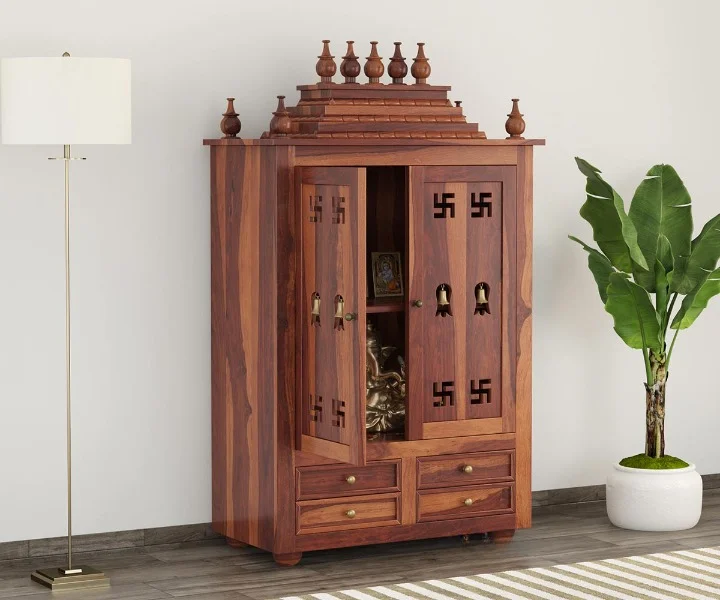
And for Indian homes of any size, Dronwood mandir collection crafted in sheesham and mango wood, meeting Vastu height requirements by design, and available with closed-cabinet options for bedroom mandir placement in home is a really sorted place to start.
Conclusion
So, to put it all together simply, mandir placement as per Vastu is not a complicated science when you break it down. Northeast corner of the home or the chosen room, minimum 2 feet above the floor, idols facing east or west, an odd number of Bhagwaan Ji’s murtis, the right material, and a clean, regularly maintained space. These things together create a pooja ghar that actually feels like a pooja ghar and not just a corner with an idol on a shelf.
Because in Indian homes, the mandir is not just a piece of furniture or a décor item. It is the energy centre of the whole house. And just like maa used to say “mandir sahi jagah pe ho toh ghar mein sab sahi rehta hai.” Get the mandir placement in home right, and everything around it follows. Bhagwaan Ji has been very patient with our incorrect setups now is a good time to fix things properly.
We will be back with the next blog soon. Till then, stay tuned!
Read More –
Top 10 Furniture Brands in India for Stylish Homes in 2026
FAQs
QCan the mandir face south in a home?
AThis is the one direction that Vastu says to avoid completely with no exceptions. South is associated with Yama, and placing the mandir or any idol facing south brings heavy energy into the home. If the current mandir placement as per Vastu is south-facing, it is worth relocating to the northeast or east corner even if it takes some rearranging. Bhagwaan Ji deserves the right direction
QWhat if the northeast corner is not available in my apartment?
AEast is the next best option for mandir placement as per Vastu. East brings the energy of the rising sun and promotes clarity during daily worship. North is also acceptable as it is the direction of Kuber. What to completely avoid is south and southwest. East and north are solid, well-supported alternatives when the northeast is genuinely not available
QCan we keep a mandir in the bedroom?
AVastu strongly advises against it, the bedroom’s energy mix conflicts with the sattvic purity a mandir needs. But if the bedroom is the only realistic option for mandir placement in home, go northeast corner only, cover idols with a cloth curtain after evening aarti, and make sure the mandir is not facing or adjacent to the bed. Never on the same wall as the headboard
QAt what height should a home mandir be placed?
ABetween 2.5 and 4 feet from the floor so the idols sit at roughly chest to eye level when standing. Bhagwaan Ji should not be looked down upon during prayers. Never on the ground floor level as that is something to fix right away if it is the current setup at home
QHow many idols should a home mandir have?
AAlways an odd number, it should be 1, 3, or 5. Even numbers are inauspicious in Vastu for mandir placement in home. One of the most common mistakes is keeping two Ganesha idols as one brought as a gift and placed alongside the existing one. The right approach is one form of each deity and odd numbers in total
QWhat material is best for a home mandir as per Vastu?
AMarble, teak, sheesham, or stone are the materials that retain positive energy and age with dignity. Sheesham wood is a popular choice in Indian homes because it is strong, naturally beautiful, and goes really well with both traditional and modern setups. For budget-conscious options, MDF with a teak-finish laminate is workable, but solid wood is always the better long-term choice for mandir placement as per Vastu
QWhat is the correct direction for the mandir in a south-facing house?
AThe direction the main door faces does not change the rules for mandir placement in home. Even in a south-facing house, the mandir goes in the northeast corner of the interior floor plan. The house may face south, but the northeast corner inside is still the northeast corner that does not flip based on which way the front door opens. Do not confuse the house facing direction with the correct interior mandir placement as per Vastu
Instagram : Dronwood
Facebook Page : Dronwood